
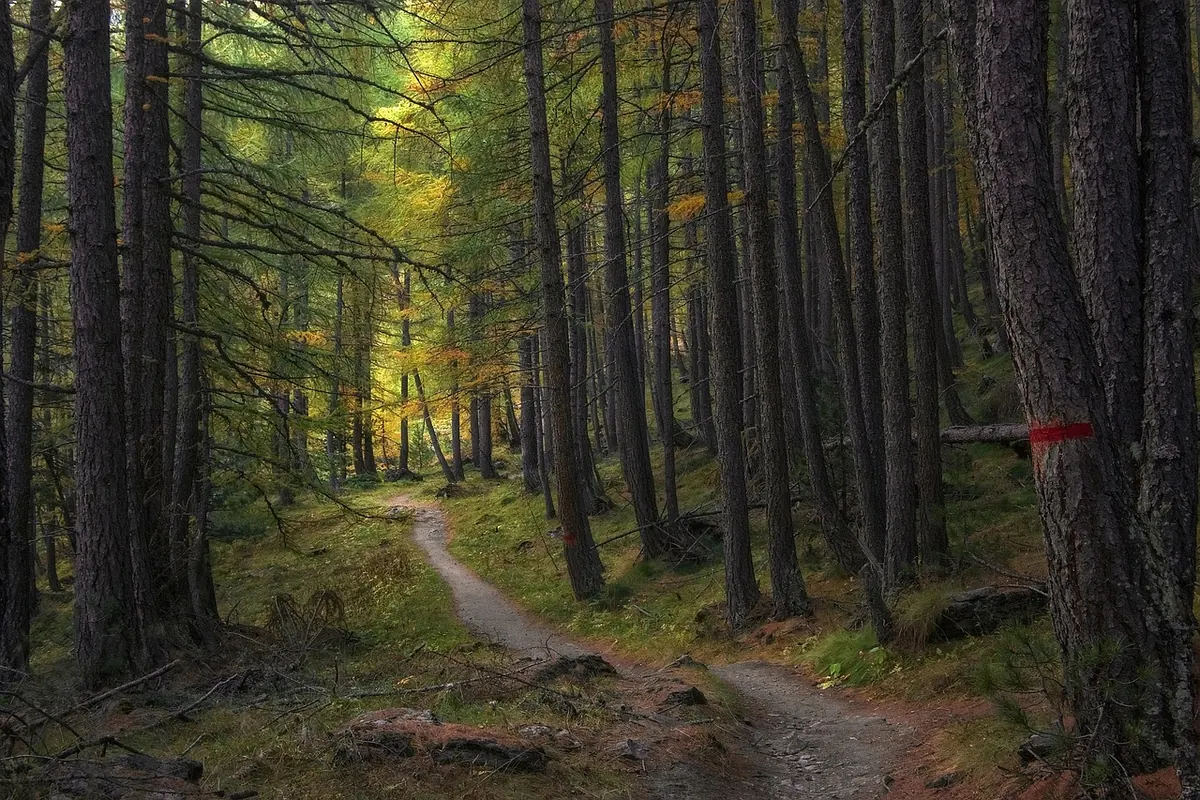
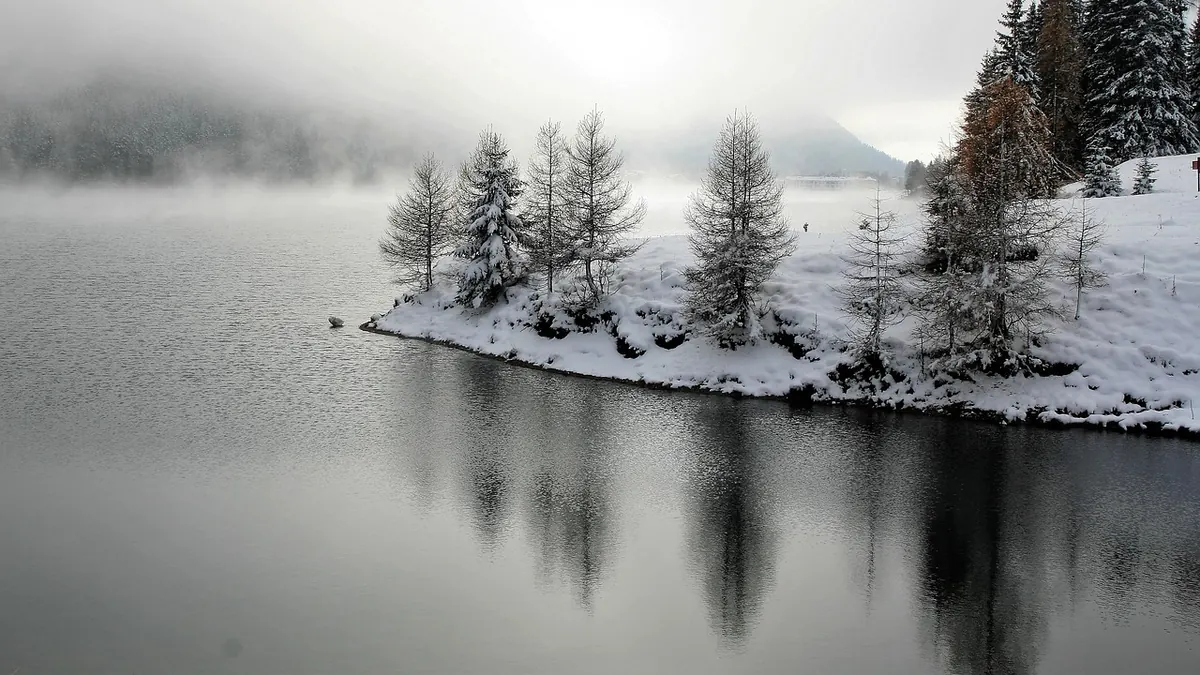
Every December, a wood that was dense with green in July suddenly develops holes. The spruces, firs and pines are still dark and needle-clad; the larches are standing bare, their branches stripped back to a fine tracery of twigs. That contrast is the easiest identification clue you will ever get, but it is only a starting point. Once you know what to look at, a leafless larch gives you plenty to read: knobbly pegs on the twigs, tiny resinous buds, cones that cling to the branches for years, and bark that changes character as the tree ages.
This guide is written for the beginner standing in a cold wood with no leaves to help. You will not need a hand lens, though one helps. You will need a low branch you can reach, a pair of binoculars if the tree is tall, and the patience to look at three or four things in the right order.
Why larches look so different in winter
Larch is a deciduous conifer. It grows needles like a pine, then throws them away like an oak. From late September the needles turn buttery gold — a colour you can pick out across a valley — and by November most trees are bare.
The timing shifts with species, altitude and weather. On a mild southern site, Japanese larch may hold its gold well into November; European larch on a cold northern hillside can be stripped by the first gales at the end of October. In a hard year, a larch will still be bare four to five months of the year, which is exactly why it pays to learn to read it without needles.
The reason for that autumn display is written into the twigs. Larch needles are carried in tufts on short woody spurs, with single needles along the young long shoots. Both kinds are shed, but the woody spurs stay behind, and they are the single most useful thing to look for on a winter larch.
The silhouette test
Stand back and look at the whole tree. A bare larch still reads as a conifer: a straight trunk, one clear leading shoot, and branches in rough tiers that shorten towards the top to give a narrow cone or spire. What you will not see is the muddle of a bare ash or sycamore — no fat rounded buds, no knuckled twig ends, no broad domed crown.
Instead you get very fine, wiry outer twigs, often with a faint droop at the tips, so the tree looks like wirework against a grey sky. Compare it with the spruce next to it: the spruce holds a dense dark skirt of needles almost to the ground, while the larch shows every branch separately. In a mixed plantation the larch is usually the one bare spire standing in a block of green. In February, that outline alone is usually enough to make you walk over and check.
In a winter wood, the first clue is often an absence. Look for the conifer that has nothing on it.
Twigs and buds: the small details
Pull a low branch gently towards you, or use binoculars if the tree is tall. The current year's shoots on a larch are slender, flexible and pale grey-brown on European larch, warmer red-brown and slightly downy on Japanese larch.
- Short shoots. On twigs two years old and older you will find tiny woody pegs, one or two millimetres long, set closely along the stem. Each one carried a tuft of needles last summer and will carry another next spring. Run a thumb along the twig and you get a rasping, studded feel that no spruce or pine twig gives you.
- Buds. Small — usually two to four millimetres — rounded to egg-shaped, and coated in a thin film of resin that catches low winter sun. On long shoots they sit singly, arranged in a spiral around the twig. At the tips of the short shoots they cluster in tiny groups.
- Colour. Buds range from chestnut brown to reddish, depending on species and the light. Do not rely on colour alone; shape, size and the resinous sheen are more consistent.
The pegs are the real giveaway, and they are worth learning by touch as well as by sight. Feel a larch twig, then feel a birch twig beside it. The birch is smooth and slightly greasy; the larch is knobbly as a rasp. Once your fingers know the difference, you will be able to name a larch in near-darkness.
Cones and bark: the evidence that lasts
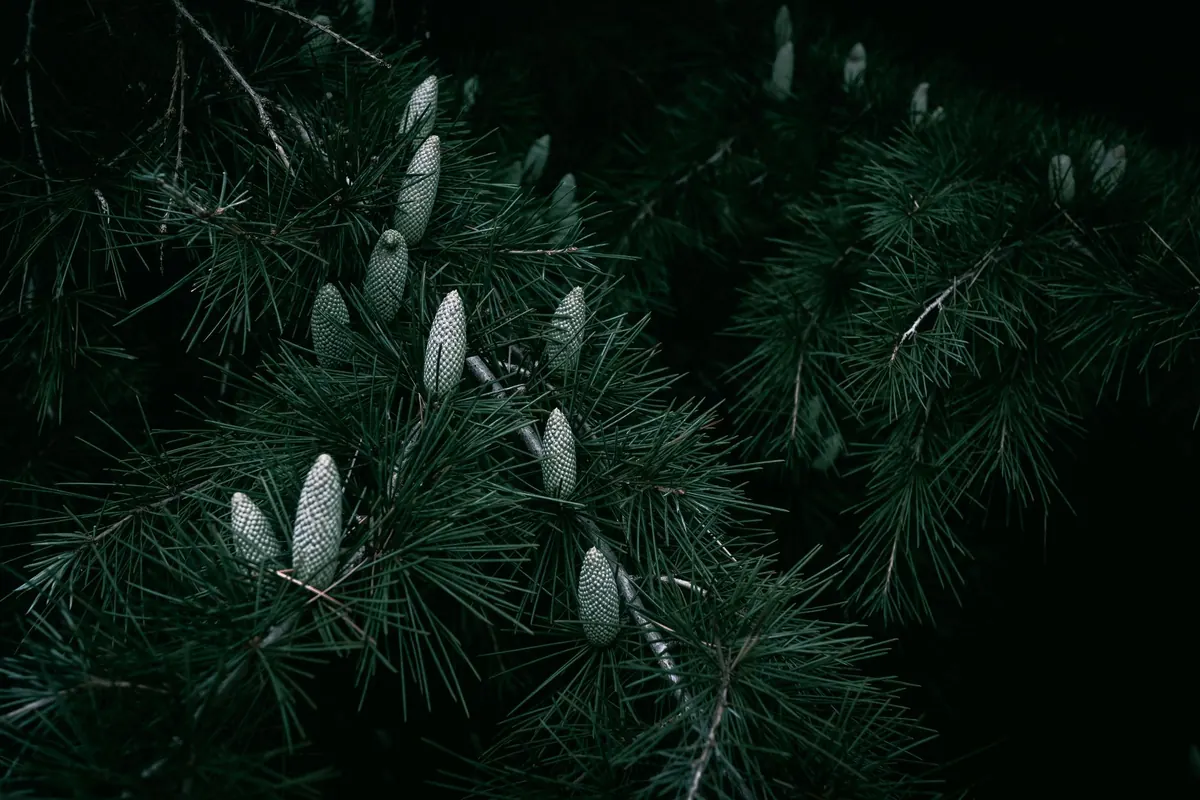
Even in the depths of winter, a larch usually carries proof of its identity on the branch. Larch cones are small — typically two to four centimetres long — egg-shaped, and they sit along the twigs rather than hanging at the very tips. They ripen from green to warm brown in autumn, then stay on the tree for several years, darkening to grey and slowly losing their scales.
That persistence is what makes them useful. On a bare February larch you can often find three generations of cones at once: last year's still holding their shape, the previous year's darker and slightly open, and older ones reduced to a woody core. No spruce or fir cone behaves quite like this, and no deciduous broadleaf carries a cone at all.
Bark adds a second layer of proof, though it changes with age:
- Young trees and upper branches. Smooth, grey-brown to greyish, often with a faint sheen and scattered resin blisters.
- Middle-aged trunks. Beginning to crack into vertical plates, revealing warmer reddish-brown wood in the fissures.
- Old trees. Deeply fissured, scaly and rugged, with thick ridges that look almost like oak bark from a distance. Japanese larch tends to run redder and to fissure at a younger age than European larch.
Lookalikes and common mistakes
Beginners usually go wrong in one of two directions. The first is mistaking a sick or dying conifer for a larch. A spruce that has been killed by drought or bark beetle will brown off and thin out, but it does not shed cleanly: dead needles hang on for months, and the twigs show none of the studded pegs. A true winter larch is stripped to the wood.
The second mistake is confusing larch with other bare trees in the same wood. Broadleaves give themselves away quickly once you learn their buds. Ash has sooty black velvety buds; beech has long, slender, coppery ones; horse chestnut has fat, sticky buds the size of a thumbnail. Larch buds are small, resinous and round, and they sit among pegs rather than on smooth twig ends.
In parkland you may also meet dawn redwood or swamp cypress, both deciduous conifers that go bare in winter. Neither carries larch's persistent cones, and both have softer, more feathery outer twigs with opposite rather than spiralled buds. If you are unsure, work through the same short sequence every time:
- Is the tree conifer-shaped but completely bare of needles?
- Do the twigs feel knobbly and studded under the thumb?
- Are the buds small, round and filmed with resin?
- Are there small egg-shaped cones sitting along the branch, including old grey ones?
- Does the bark crack into reddish vertical plates on older trunks?
Five yeses means you have a larch. Two or three means you have found something else, and it is worth looking again. With practice the whole check takes under a minute, and it works on a hillside in January just as well as it does in a car park in March. Learn the pegs first, and the rest of the tree will explain itself.
Photo: pasja1000 / Pixabay
Related posts
More stories you’ll love reading