
Conservation
Larch and Conservation in the UK: Benefits, Risks and Responsible Planting
October 06, 2026
Larch is the conifer that behaves like a broadleaf. It flushes soft green needles in spring, turns butter-yellow in autumn and then drops the lot. That alone makes it one of the most distinctive trees in the British landscape — and one of the most argued about. Foresters value it, red squirrels feed on it, and Phytophthora ramorum has been felling it across the wetter west for years. Whether larch helps or harms conservation comes down to two questions: where is it planted, and what was growing there before.
What larch brings to the landscape
The larch most people meet in Britain is Japanese larch, European larch or the hybrid between them. All three share the same useful habit: a light, open canopy. Sunlight reaches the forest floor in a way it never does under Sitka spruce or dense Scots pine, so grasses, heather, bilberry and woodland flowers can persist underneath. Larch needles also break down more readily than spruce litter, so soils under larch tend to stay less raw and acidic.
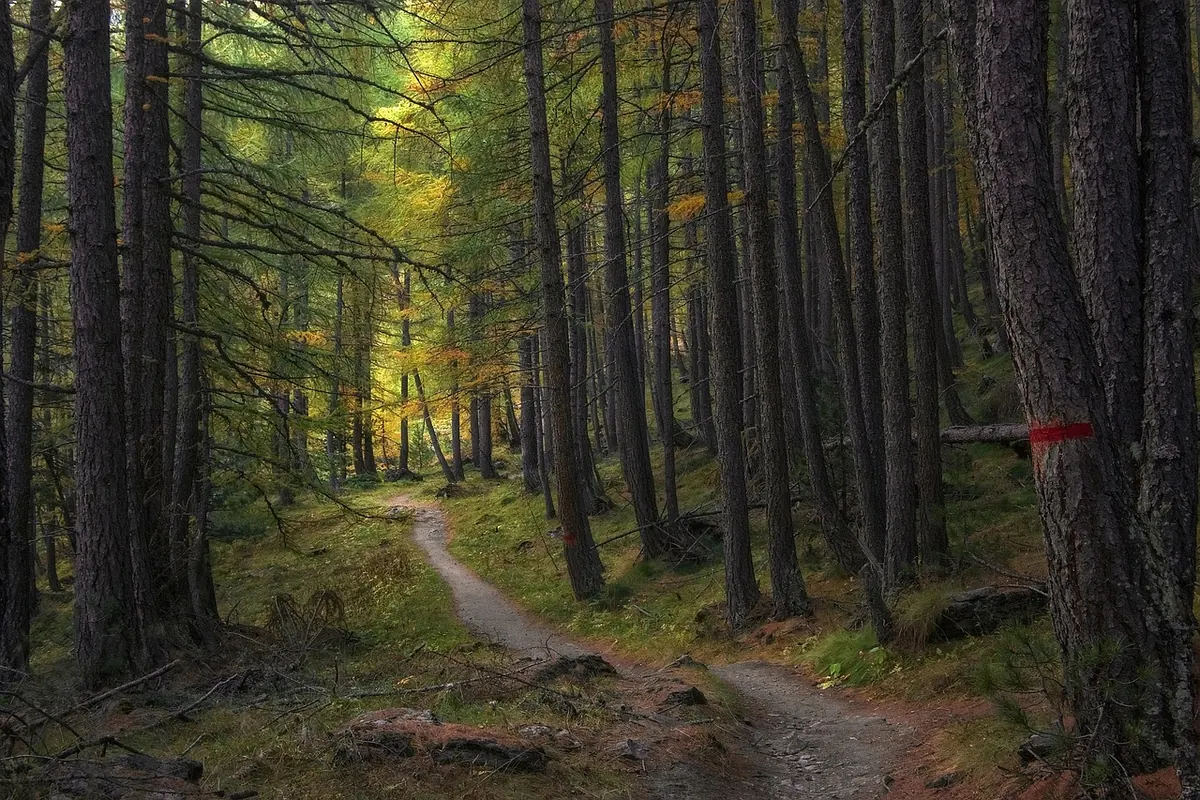
Visually, larch does work nothing else can. On an upland edge or a shelterbelt, its spring green and autumn gold break up the flat darkness of a conifer block. Its timber is genuinely good, too — durable, straight-grained and useful for fencing, gates, cladding and small boat work. That economic value matters more than it might sound: woodland that pays its way is woodland that gets managed, thinned and kept as woodland.
The wildlife case for larch
Larch is not a wildlife desert. Its small cones carry seed that siskins, lesser redpolls, crossbills and red squirrels will take, and its structure suits nesting birds. Older trees, particularly in the wetter west, can carry useful lichen and bryophyte communities on their bark.
Its real ecological strength is what grows beneath it:
- A richer field layer than dense conifer crops, including heather, bilberry and grasses that support invertebrates.
- Mycorrhizal fungi with larch as their only tree partner — the larch bolete is the best-known example.
- Insects that specialise on larch rather than ignoring it, giving birds and bats something to feed on through the season.
- Edge and shelter value where larch is used in small groups or as a nurse crop rather than in solid blocks.
Put simply, a scatter of larch inside a broader mix is usually a net gain for wildlife. A hundred hectares of larch on a heath is not.
The risk: Phytophthora ramorum
Phytophthora ramorum is a water mould, not a fungus, and it has reshaped larch planting in Britain. It spreads in wet conditions — rain splash, wind-blown mist and, importantly, along watercourses — and it also travels on muddy boots, tyres and machinery.
Japanese larch is the most susceptible and produces enormous quantities of spores, which can then infect other hosts including bilberry, rhododendron and several tree species. European larch is more resistant; hybrids sit somewhere in between. Symptoms to watch for include dark, bleeding lesions on trunks, blackened or wilted shoots, thinning crowns and patches of dead bark. Where infection is confirmed, stands may be served with statutory plant health notices requiring felling, and large areas of the south-west, Wales and western Scotland have gone that way.
The conservation damage is not only the loss of the larch. It is the sudden clearfell of a whole hillside, the erosion and run-off that follows, the collapse of a mixed-age structure, and the hit to red squirrel strongholds where larch was part of the food supply. Once the disease is present, it also narrows what you can replant with confidence.
Where larch does real harm
Larch is not native to Britain. European larch has been planted here since the seventeenth century and Japanese larch since the nineteenth, so it feels established, but it is still an introduced tree — and it behaves like one in the wrong places.
- Ancient semi-natural woodland. Planting larch over an ancient woodland site buries the ground flora, seedbank and soil structure that make the site special.
- Blanket bog and deep peat. Drainage, fertiliser and shade on peat means carbon loss and damaged hydrology. Larch has no place there.
- Upland heath and moorland edges. Larch seed is light and germinates freely on open ground, so it can seed away from the site and scrub over heather.
- Riparian corridors. Because the pathogen moves in water, planting larch beside a burn or upstream of a sensitive site stacks the odds against you.
- Next to other hosts. Rhododendron in particular can shelter the disease and keep it cycling in the landscape.
Ancient woodland restoration
Where larch sits on an ancient woodland site, it is one of the more manageable problems to solve. Larch is shade-intolerant and does not regenerate strongly under its own canopy, so progressive thinning, ring-barking or group felling can let remnant ground flora and the seedbank respond. Because its litter is less acidifying than spruce, recovery of the field layer is often quicker than under a dense conifer crop. The one thing to plan for is seed source: if mature larch remains nearby, expect seedlings on any open ground you create.
Before you plant: a short practical checklist
If you are considering larch — in a woodland, a shelterbelt or a large garden — work through this first.
- Check the local disease picture. Find out whether Phytophthora ramorum is known in your area before you commit.
- Keep larch away from water. No planting along watercourses or above sensitive catchments.
- Rule out peat, bog and ancient woodland. These are non-starters, whatever the grant regime says.
- Choose the species deliberately. Where larch is appropriate, European and hybrid larch are generally the lower-risk choices.
- Plant in mixtures, not blocks. Scattered larch is more resilient and far less damaging to fell if disease arrives.
- Plan for early felling. Assume a shorter rotation than you would like and keep access and restocking options open.
- Practise basic biosecurity. Brush mud and plant debris off boots, tyres and tools before moving between woods.
- Report suspect trees. In Britain, TreeAlert is the recognised route for reporting possible tree pest and disease problems.
- Take advice at scale. For anything more than a handful of trees, speak to a forestry agent or the relevant national forestry body about felling licences, grants and restocking.
Larch is not a villain, and it is not a free win. Used sparingly, in the right soil, away from water and away from ancient woodland, it adds colour, timber and wildlife value that few conifers can match. Used as a blanket crop on sensitive ground, it creates problems that outlast the trees themselves. The decision is mostly about restraint.
Photo: mostafa_meraji / Pixabay
Related posts
More stories you’ll love reading